
Exodus 12:1-20
“Now the blood shall be a sign for you on the houses where you are. And when I see the blood, I will pass over you; and the plague shall not be on you to destroy you when I strike the land of Egypt.”
The night was different from all other nights. In small homes across the land of Goshen, Hebrew families were busy with unusual activities. Instead of getting ready for bed, they were cooking special meals and packing their belongings. Children watched with wide eyes as fathers carefully painted doorframes with blood from lambs.
“Why are we doing this, Abba?” a young girl might have asked her father.
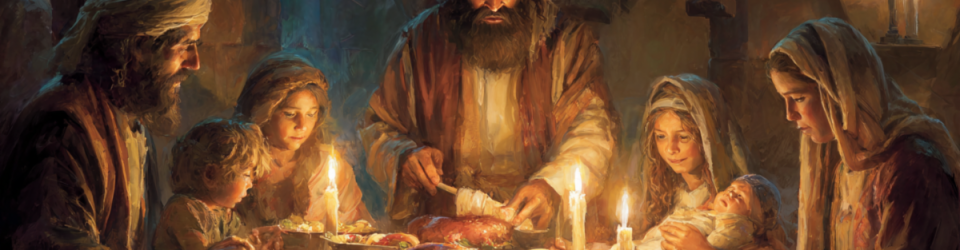
“Because tonight, God is going to free us,” he would answer, paintbrush in hand. “Tonight, everything changes.” Imagine the scene: thousands of Hebrew homes, each with a lamb’s blood marking the doorposts. Inside, families dressed in traveling clothes eating roasted lamb, bitter herbs, and bread made without yeast. Their sandals on their feet, staffs in their hands, ready to leave at a moment’s notice.
What’s amazing about this story is that God didn’t give the people instructions about how to escape from Egypt. You might expect Him to say, “Pack light!” or “Here’s the fastest route to the Red Sea.” Instead, He told them how to celebrate—how to worship Him through a special meal. The meal itself was full of meaning. The lamb had to be perfect, with no flaws or problems. It had to be killed at twilight, and not a bone could be broken. The blood had to be painted on the doorposts. The meat had to be roasted with fire, not boiled or eaten raw. They had to eat it with bitter herbs and bread without yeast. And they had to eat it all—nothing could be left until morning.
Every detail was important. The perfect lamb pointed to Jesus, who would one day die as the perfect sacrifice. The blood on the doorposts showed how Jesus’ blood would save people from death. The bitter herbs reminded them of their bitter slavery. The bread without yeast (which makes bread puff up with air) taught them not to be puffed up with pride. Eating in a hurry, dressed for travel, showed that salvation leads to a journey with God. The most amazing part of this story is that the Israelites were told to celebrate their freedom before they were actually free! They were still in Egypt, still surrounded by their slave masters. But God wanted them to act out their faith—to celebrate what He was about to do as if it had already happened.
This first Passover wasn’t just a one-time event. God told the people to celebrate it every year as “a lasting ordinance.” He wanted each new generation to experience the story as if they themselves had been freed from Egypt. When children asked, “Why do we do this?” parents could explain God’s mighty acts of salvation. Even today, Jewish families celebrate Passover with a special meal called a Seder. They tell the story, ask questions, eat symbolic foods, and sing songs of praise. Christians see in this celebration a picture of what Jesus did for us. The apostle Paul wrote, “Christ, our Passover lamb, has been sacrificed for us” (1 Corinthians 5:7).
The first Passover teaches us that worship comes before work, celebration before struggle. God wanted His people to have a celebration meal before their wilderness journey because He knew they would need to remember His goodness during hard times ahead.
When we face difficult journeys in our own lives, we too can look back at what God has already done for us. We can celebrate His goodness even before we see His next miracle. Like the Israelites with blood on their doorposts, we can trust that God sees us, protects us, and will lead us to freedom.
Did You Know? Archaeologists have found that many ancient cultures used blood to mark doorways as protection against evil. But the Passover was different—it wasn’t magic or superstition. The blood was a sign of faith in God’s promise. In Egypt, blood usually meant death, but for the Israelites, blood on their doors meant life! Today, Passover is one of the oldest continuously celebrated holidays in the world. Jewish families have been remembering this meal for over 3,500 years, making it one of history’s most enduring traditions.
🔥 Personal Reflection:
- How does celebrating what God has done in the past help you face challenges today?
- What “bitter herbs” (hard experiences) in your life has God turned into something good?
- If you were to create a meal that tells your own story with God, what foods would you include and why?
🙏 Prayer: Dear God, thank You for the amazing story of the first Passover. I’m amazed that You told the Israelites to celebrate before they were even free! Help me to have that kind of faith—to thank You for answers before I see them. Like the Israelites marked their homes with lamb’s blood, I claim the protection of Jesus’ blood over my life and family. During hard times, help me remember how You’ve saved me in the past. Thank You for Jesus, my perfect Passover Lamb, who died so I could live. Help me share this wonderful story of salvation with others, especially children who need to know about Your love and protection. In Jesus’ name, Amen.
0 Comments