
Exodus 11:1-10; Micah 6:8
“And Moses said, ‘Thus says the LORD: “About midnight I will go out into the midst of Egypt; and all the firstborn in the land of Egypt shall die, from the firstborn of Pharaoh who sits on his throne, even to the firstborn of the female servant who is behind the handmill, and all the firstborn of the animals.“
In the beautiful city of Alexandria where the Nile River meets the Mediterranean Sea stands the modern Library of Alexandria. Inside this amazing building shaped like a rising sun, old Egyptian papers tell us how ancient Egyptians believed in judgment after death.
These papers show something important: the number ten was special in ancient times. It meant “complete” or “finished.” The Egyptians even had ten things a dead person had to confess to enter the afterlife. Now, after nine terrible plagues, Egypt faced the tenth and last one. God’s full answer to Pharaoh’s stubborn heart was about to come. Three days of complete darkness had just ended in Egypt—days when Egyptians couldn’t see anything, while the Israelites had light in their homes. Those three dark days were a chance to think and change. But Pharaoh still refused to listen.
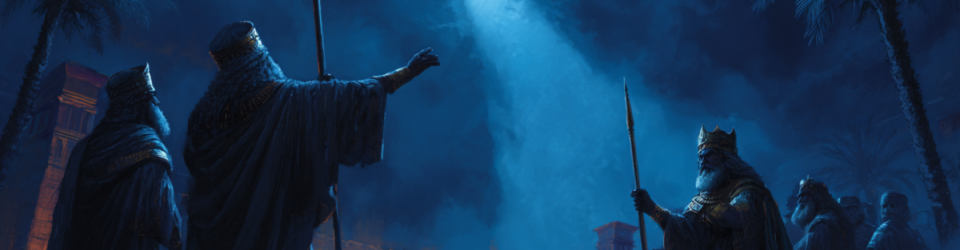
So Moses went to Pharaoh’s palace one last time. Even though Pharaoh had threatened to kill him if he ever came back, Moses delivered God’s final message: “At midnight, all the firstborn in Egypt will die.” These terrible words filled the room with heavy silence. Digging at ancient Egyptian tombs shows us how special firstborn sons were. They got twice as much inheritance as other children. In royal families, they became the next king. Firstborn sons were Egypt’s hope for the future. God’s last judgment would strike at the heart of Egypt’s pride.
What makes this warning so powerful is that God had already given Pharaoh nine chances to change. Each plague was both a show of God’s power and a gift—another opportunity to avoid disaster. When Moses left Pharaoh, the Bible says he was “very angry.” This wasn’t just being mad. Moses knew what was about to happen—thousands of innocent children would die because one stubborn leader wouldn’t listen to God. Pharaoh’s pride would cost his people dearly. This story teaches us something important: God always warns before He judges. He always gives chances to turn around. But when someone keeps refusing to listen, bad things eventually happen.
Scientists digging in Egypt have found mass graves from this time period. While they debate what caused so many deaths, these graves remind us that the Bible tells about real events that happened to real people. The prophet Micah later taught that God wants three things from us: “to do what is right, to love being kind, and to walk humbly with your God.” In this final warning, we see all three. Justice was coming. Kindness had been offered many times. Now only humility could save Egypt from disaster.
The hard lesson from Egypt’s story is simple: when God warns us, we should listen. When God offers mercy, we should take it. And when God asks us to change, being humble is always better than being proud.
Did You Know? In ancient Egypt, the oldest son had a special job after his father died. He had to make sure his father was buried properly and given special offerings to have a good afterlife. Without the oldest son doing these things, Egyptians believed the dead person would suffer forever. That’s why God’s judgment on the firstborn was so serious—it affected both Egypt’s future (the children who would grow up to lead) and its past (the proper care of dead parents). Archaeologists have found places in Egypt where many people were buried quickly at the same time during this period, showing that something caused many sudden deaths—just like the Bible describes.
🔥 Personal Reflection:
- When have you ignored warnings that could have saved you from trouble?
- How do you try to be both fair and kind when dealing with people who’ve done wrong?
- What proud attitudes might be stopping you from hearing what God is telling you today?
🙏 Prayer: Dear God, the story of Your final warning to Pharaoh teaches me important lessons. Thank You for being patient and always giving warnings before trouble comes. Help me pay attention to Your warnings in my own life. Keep my heart soft when You speak to me, not hard like Pharaoh’s was. Show me how to be fair but also kind, and to stay humble when dealing with others. When I see people heading for trouble because of bad choices, help me feel sorry for them instead of judging them. And when I need to tell hard truths to others, help me do it with both strength and love, like Moses did. In Your name, Amen.
0 Comments