
“So Moses came and told the people all the words of the LORD and all the judgments. And all the people answered with one voice and said, ‘All the words which the LORD has said we will do.'” — Exodus 24:3 (NKJV)
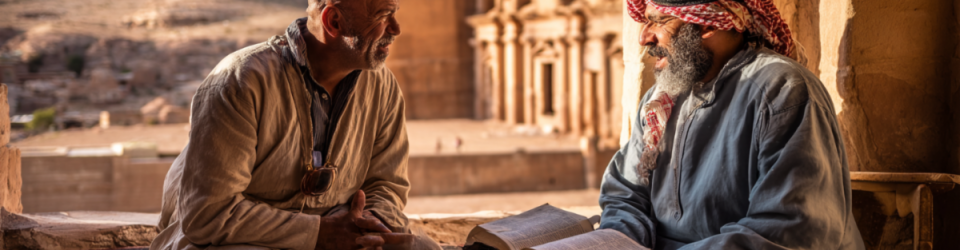
The afternoon sun shone on the ancient stones of Petra (Jordan’s famous site carved into red cliffs) as Mahmoud finished his tour guide work. Walking home through Wadi Musa village (the town near Petra), he stopped at the small Christian church where his friend Pastor Yussef was preparing for evening prayer.
“Welcome,” Pastor Yussef called out warmly. “How was your day?”
Mahmoud sat down with a tired smile. “Tourists keep asking how the Nabataeans (ancient people who built Petra) created such amazing buildings but then disappeared. Big promises in stone, but they couldn’t keep their people together.” Pastor Yussef opened his Arabic Bible. “That reminds me of the Israelites at Mount Sinai. They promised with all their hearts: ‘Everything the Lord says, we will do.'”
“Did they keep their promise?” Mahmoud asked. “Within weeks, they were worshipping a golden calf while Moses was still on the mountain getting the law from the Lord.” The evening call to prayer echoed from the nearby mosque (Islamic place of worship), a familiar sound in their village. “I understand their problem,” Mahmoud said quietly. “Every Ramadan (Islamic holy month), I promise to be more faithful. I really mean it. But by the end of the month, I’m back to my old ways.”
Pastor Yussef nodded. “That’s why the covenant ceremony included blood, not just promises. Moses sprinkled blood on the people after they made their promise. The blood meant they needed help they couldn’t give themselves.”
As darkness came over the desert, both friends sat thinking. “The Quran (Islamic holy book) teaches that humans are weak,” Mahmoud said. “But I always think I can do better by myself.”
“The Bible teaches the same,” Yussef replied. “We can make honest promises, but we need help to keep them. The blood pointed to Christ’s sacrifice—not just forgiveness when we fail, but power to actually obey.” Young people walked past, laughing loudly. Both men smiled. “They’re like the Israelites,” Yussef said. “So sure they can do anything. Life hasn’t taught them how weak we are yet.”
As they said goodbye, Yussef put his hand on his friend’s shoulder. “Whether Christian or Muslim, we both know we need mercy. Maybe the difference is believing that mercy gives us power to change, not just forgiveness.”
Under the star-filled sky, both men thought about the same old question: How do we keep the promises we really want to keep?
Did You Know? In ancient Middle Eastern agreements, both people would walk between cut-up sacrificed animals, basically saying, “Let this happen to me if I break my promise.” But when the Lord made His agreement with Abraham (Genesis 15), only the Lord passed between the pieces while Abraham slept. This showed that the Lord took full responsibility for keeping the agreement. At Sinai, the blood sprinkled on the people meant the Lord would provide what they couldn’t—pointing to Christ who would do what they couldn’t do themselves.
🔥 Personal Reflection:
- What honest promises have you made that you’ve found hard to keep?
- How does knowing that keeping promises requires help from above change how you think about trying to be good?
- Where in your life do you need to stop trying so hard on your own and start asking for help?
🙏 Prayer: Dear Lord, like the Israelites, I’ve made honest promises to follow You, only to find out how weak I am. Thank You that You provide what I can’t. Help me depend on Your power, not my own efforts. When I fail, remind me of Christ’s sacrifice. When I succeed, let me remember it’s Your strength in me. In Jesus’ name, Amen.
0 Comments